
Roller Blinds
Motorisation pairs with roller fabric across a single window or a whole glazed wall.
Explore →Home / Products / Motorised Blinds & Automation
Product Guide
On the double-volume lounges and wide sliding walls common across Inanda's newer builds, motorisation stops being an upsell and starts being the only practical way to run the blinds day to day.
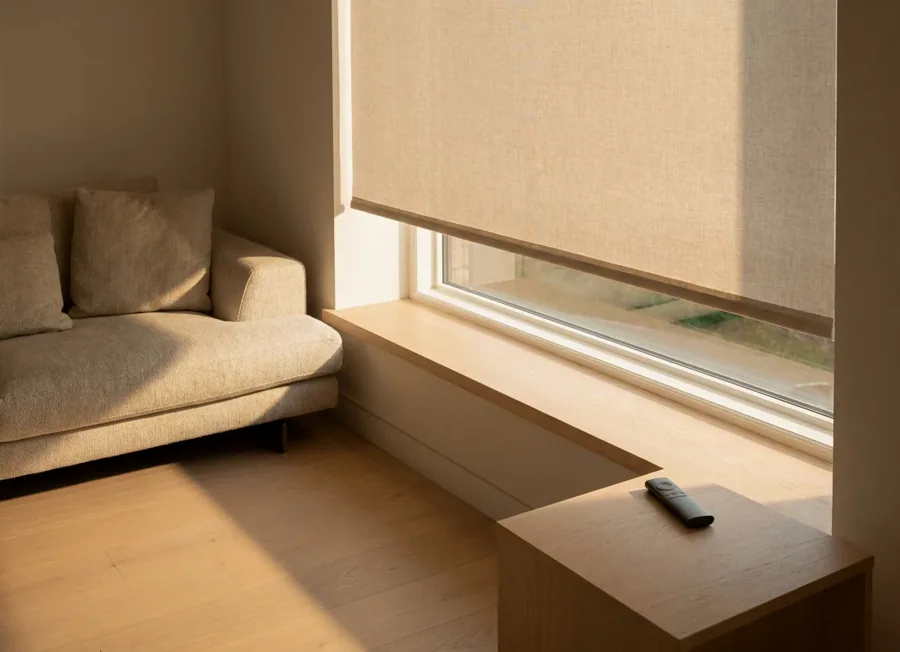
Rechargeable battery motors need no wiring and suit a retrofit on an existing home, charged every few months. Wired motors suit new builds and renovations — permanent, no charging, and the better fit for big or heavy systems and anything mounted outside. Because many Inanda properties already run generator or inverter backup for load-shedding, wired motorisation is often the simpler long-term choice on a full-house fit-out rather than a retrofit patch.
A single multi-channel remote can run every blind in a room. App control means checking from the stable yard whether the west lounge blinds are still up. Schedules drop west-facing blinds automatically as the afternoon sun swings round, and sun sensors do the same without anyone remembering to press a button. On anything mounted outside — external venetians, awnings, zip screens — a wind sensor that auto-retracts before a highveld thunderstorm gust hits is the responsible spec, not an optional extra.
Spans too wide or heavy for a chain, blinds above a stair void or double volume, concealed ceiling-recess systems, and anything fitted outside the glass — on all of these, motorisation is essentially required rather than a nice-to-have. "One button, six blinds" is a common ask on Inanda's bigger glazed walls, and it's exactly what a linked motorised system is built to do.
No dangling chains makes motorised operation the most child-safe option there is. The motors themselves are quiet, not silent, and quality units carry a multi-year guarantee. Battery motors do need that periodic charge — we set the expectation at quote stage, not after installation.
Motorisation is priced by whatever it is driving, so the honest answer is a range: about R2,500 to R7,500 per square metre installed across the products on this site. Count on R2,500 to R3,800 per square metre for a motorised blockout or sunscreen roller, R4,500 to R6,500 for motorised external venetians, and R5,500 to R7,500 per square metre of projection for an awning driven by a motor and a wind sensor.
All of those are guide bands per square metre installed and none of them is a quotation; small windows still carry a minimum charge. What decides the actual figure is the room: how many blinds share a control, whether a battery tube or a wired motor suits that wall, and how far the nearest power point is. The free measure settles all of it, with the written per-window price to follow.
Not sure this is the right product for your elevation? The Inanda Paddock-Light Field Guide works through north, west, east and south glass in turn, and says plainly where this one wins and where it doesn't.
Wide, high or multi-room glass calls for the same motorised answer wherever it sits — this is close to the default spec on the big renovations in Hyde Park and Sandhurst, and comes up just as often on Atholl's mansions and Bryanston's larger stand-alone homes.
A consultant will assess the spans, the power options, and the right control layer for your rooms.