Home / The Field Guide

A Free Shading Guide — Inanda, Sandton

The Inanda Paddock-Light Field Guide What the highveld sun actually does to a wide-glass house on an open Inanda stand — window by window, season by season.

About 8 minutes Written August 2026 No email needed Sources at the foot
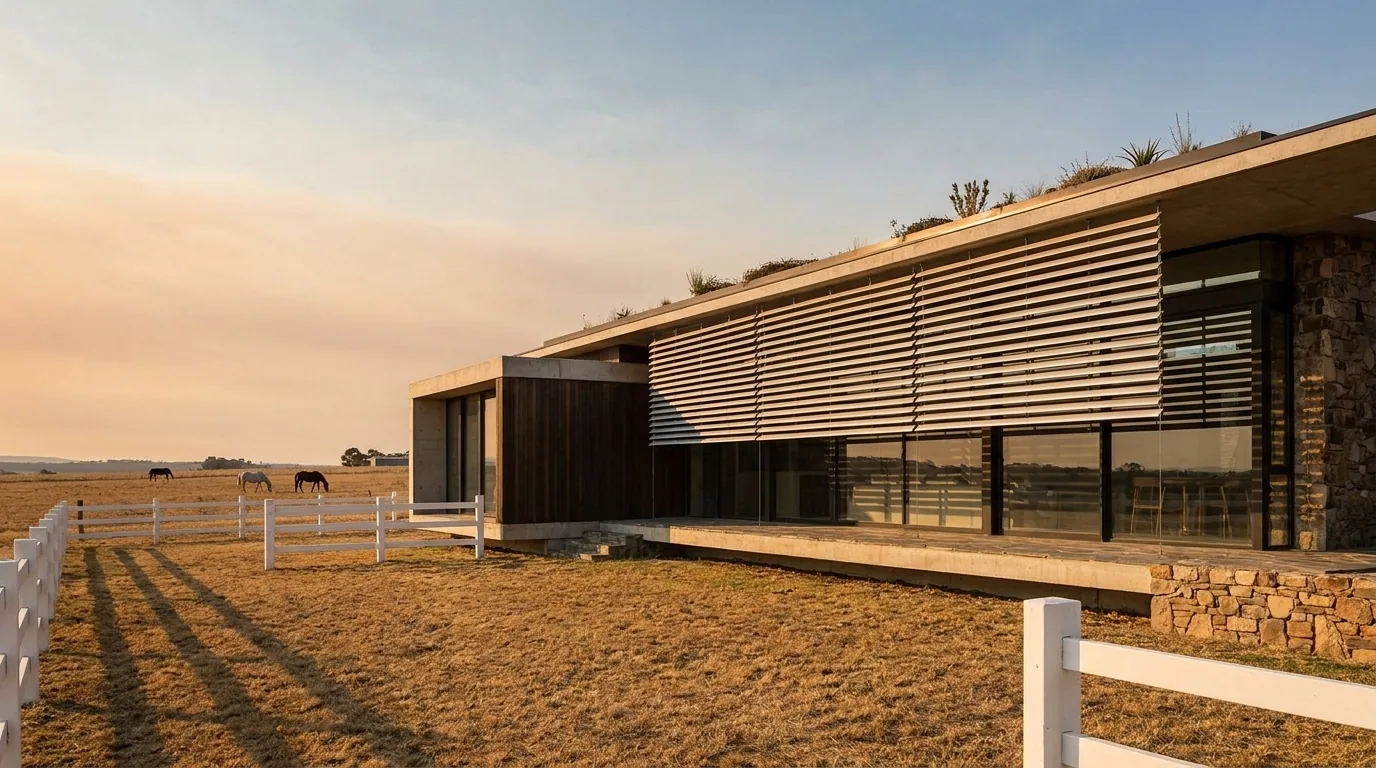
A low contemporary estate house across a grazed paddock and white post-and-rail fencing, its wide glazed living wall shaded by external venetian blinds — horizontal aluminium slats mounted outside the glass — in late highveld afternoon light
Free to read — nothing gated
Written for this suburb, not a template

01 — The ground here

Why a suburb this small gets its own shading brief.

Inanda is tiny and unusual: 0.55 km², 842 residents at the 2011 census[1] — a pocket of large stands wrapped around a polo ground about 1.5 km from Sandton City[1], bordered by Atholl, Illovo and Parkmore[2]. It was farmland before Sandton grew around it[2][3]; the club at its centre opened in April 1935[4]. (This is the Sandton Inanda — the polo one — not its namesake in KwaZulu-Natal.)

Nothing next door is shading you. On a denser stand a neighbour's wall quietly removes an hour of early or late sun from your glass. Here the properties are large[2], the streets are wide[3], and there is open ground in the middle of the suburb — so the sun reaches your glazing uninterrupted all day.

The glass is aimed at the view, not the street. When the outlook is a paddock, living areas get built to face it and the glazing runs wider than a standard window. That shifts the question from "which fabric" to "how does this get operated twice a day" — a chain across a four-metre span stops being reasonable fast.

The trees shade you generously, for half the year. Inanda sits in a corridor of green with mature old trees[2], and Johannesburg holds roughly six million trees, 4.8 million of them in private gardens[6]. A deciduous canopy takes the edge off January and is bare by July, so a room's light budget swings twice a year: with the sun's angle, and with the leaves. One observation of our own, not a cited fact: on a stand with a working yard, fine sand travels onto slats and fabrics.

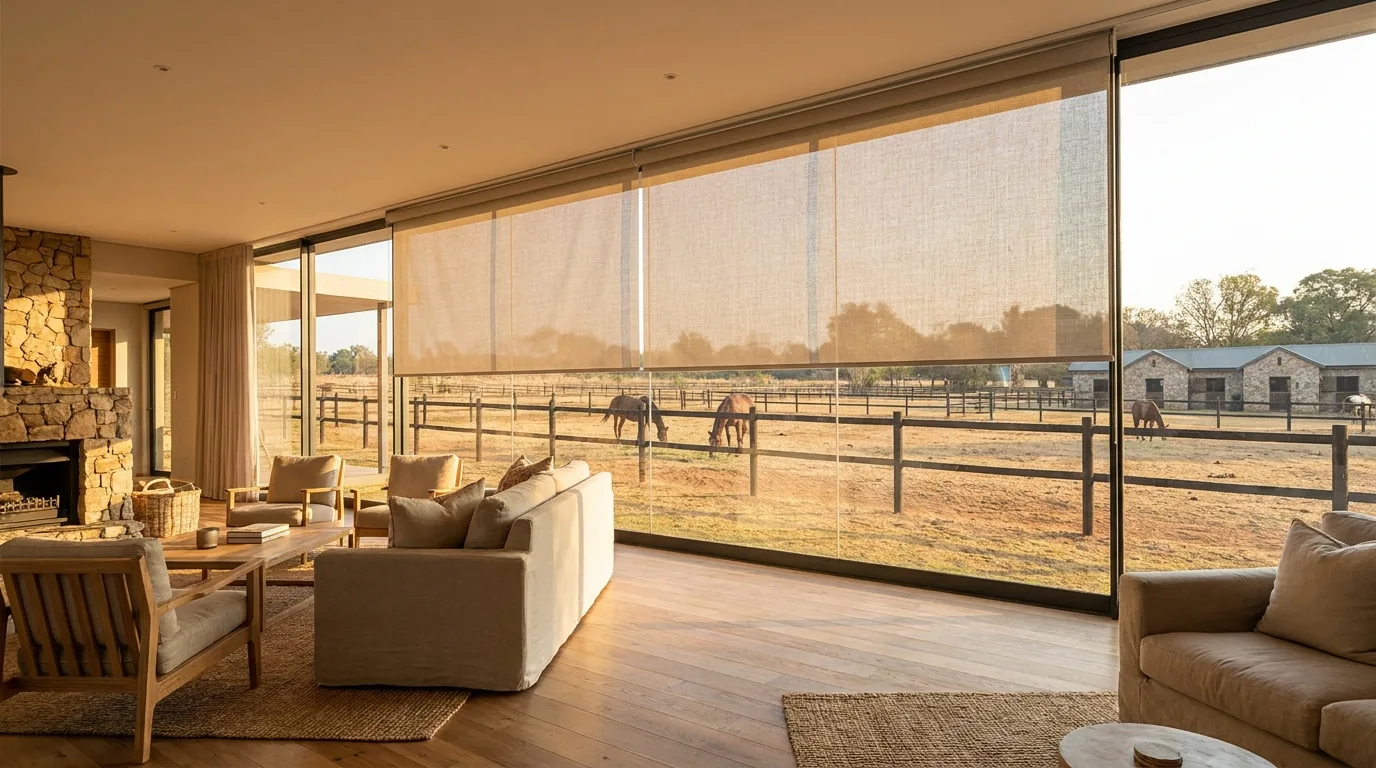
Wide living-room glazing seen from inside an Inanda-style home, with flat open-weave sunscreen roller blinds lowered across the upper glass, softening late afternoon glare while horses, paddock fencing and stables stay visible through the weave
Late afternoon, west glass. An open-weave sunscreen holds the glare down without deleting the paddock — the compromise most wide-glass living rooms here are actually after.

02 — The light here

What the highveld sun does over an open Inanda stand.

Inanda sits at roughly 26.12° south[1], on a plateau — Johannesburg stands 1,753 m above sea level[6]. The nearest published sun-geometry work is calculated for Pretoria, half a degree north, and holds here to within a degree: at solar noon the sun reaches 87.7° above the horizon on 21 December and only 40.84° on 20 June[5]. That 47-degree swing splits the year in two.

Midsummer noon is nearly overhead, so a north window with any eave above it largely shades itself in January. In midwinter the sun sits at about 41° and due north, driving warmth deep into the room — which, with June and July nights near 4.1 °C and the odd frost[6], you want. Blanking that out is a real loss, not a neutral choice.

The afternoon is the problem. On 21 December the sun sets at an azimuth of 243.35° — about 27 degrees south of due west[5]. From mid-afternoon it arrives low and almost horizontally, and an overhang cannot block a horizontal ray: the same study notes how much hotter western-exposure afternoons run than mornings, and that horizontal overhangs suit high, altitude-dominated angles — northern facades — not low ones[5]. On the west you need something at the glass or outside it, not above it.

Three more facts that change the specification

  • Afternoon storms. Thundershowers run November to March, and most of Johannesburg's 713 mm of annual rain falls then[6]. Anything that folds out over a veranda has to fold back in fast, so a wind sensor is specification, not upsell.
  • Hail. South African hail concentrates along the Highveld, is most frequent from mid-November through February, and peaks in the afternoon[7] — reason enough to fit an exterior product that retracts rather than one that stays put.
  • Altitude and ultraviolet. UV rises about 12% per 1,000 m of altitude because thinner air filters less of it[8], and at 1,753 m that is a real difference. On a west window choose fabric on performance first, colour second.

03 — Room by room

Elevation by elevation, and which rooms suffer.

One house, four problems. Work out which wall a room sits on first — it decides more than the fabric does.

North — protect in summer, open in winter

North is where the sun lives all winter: high enough in midsummer that an eave does much of the work, then at about 41° and pouring straight in by June[5].

Living rooms and studies want something adjustable — light thrown onto the ceiling in January, open flat in July. A blockout roller is blunt here: down costs the winter warmth you were entitled to.

Verdict Adjustable beats absolute.
West — the elevation that costs you the room

Low, near-horizontal sun from mid-afternoon, arriving 27 degrees south of west at midsummer[5], across ground with nothing on it to break the light. This is where wide Inanda glazing hurts most.

If a west room is unbearable by four, the glass itself is heating and radiating inwards. An interior blind fixes the glare at once and the heat only partly — once the sun is through the pane, the energy is in the room.

Verdict Stop it outside the glass if you can; a proper sunscreen if you can't.
East — glare first, heat second

The same geometry mirrored — a midsummer sunrise at azimuth 116.62°[5] — into a house that cooled overnight. Bedrooms wake with it; a kitchen takes an hour of glare and it's over.

Two rooms on one wall wanting opposite things: properly dark where you sleep, still see-through where you make coffee.

Verdict Solve for sleep and glare, not heat.
South — even, cool, and quietly forgotten

Almost no direct sun for most of the year, so south rooms hold the steadiest light in the house — and are the coldest come June[6].

Shading is rarely the problem here; heat loss through a big pane usually is. On a large stand the south face also tends to look at the working yard, which makes it a privacy question too.

Verdict Think warmth and privacy, not sun.
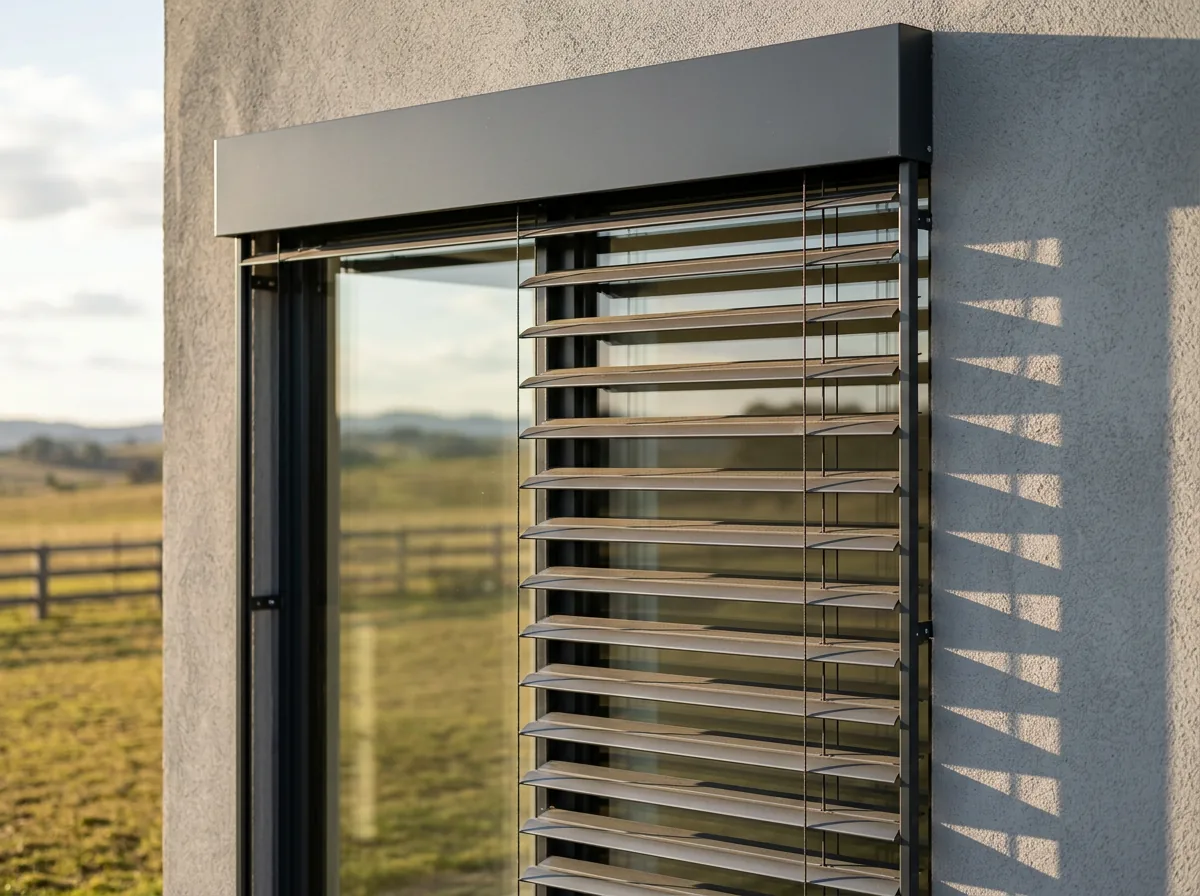
Close detail of an external venetian blind on a west elevation: a slim aluminium headbox above the window and wide horizontal slats running in narrow vertical guide rails outside the glass, tilted against low sun, with open grassland and paddock fencing beyond
Stopped outside the glass. External venetian slats in side guides, tilted against a low west sun — the heat never reaches the pane, and you keep a view out through the slats.

Optional

Want this guide marked up for your own house?

Tell us which rooms are giving you trouble and we'll email you this same guide with your elevations noted against it — which windows we'd treat first, and what we'd be weighing up on each one.

It's an email, not a visit. Nobody phones you about it.

POPIA: your details are used only to send you this guide and, if you ask for it, to arrange your free in-home measure. They are never shared with anyone else.

04 — The specification

What we'd fit in Inanda, and the catch with each.

Each is right somewhere in this suburb and wrong somewhere else; the trade-off box is what brochures leave out. Add anything that sounds like your house — it carries into the form below.

Sunscreen roller blinds

West & north living glass

One flat sheet of open-weave fabric on a slim tube — no folds. It cuts glare and a useful share of the solar gain while the paddock stays visible. Better here than a heavy curtain, which solves four o'clock by deleting the view.

The trade-off

It reverses after dark: lights on inside, and you are the display. Where the approach road is close, pair it with a blockout on a double bracket.

Blockout roller blinds

Bedrooms · east elevations

A single smooth sheet with no folds to hold the dust off open ground. Against a December sunrise on an east bedroom window, nothing beats it.

The trade-off

Binary — down is dark, up is everything — so it is the wrong tool on a north living room where the winter sun is worth keeping. Without side channels, light finds the reveal edge.

Day & night blinds

Driveway- and yard-facing rooms

Alternating sheer and solid bands on one tube: shift them and you go from open view to full privacy without going dark — which a plain blockout cannot do.

The trade-off

It is not a blockout, so a light sleeper still wakes with the sun — and the banded look is a design decision in itself.

Venetian blinds (timber or aluminium)

North rooms · studies · wet areas

On north glass the useful control is angle, not coverage: a venetian throws high summer sun onto the ceiling and opens flat in June, so one product covers both ends of that 47-degree swing[5] where a roller can only be up or down.

The trade-off

Slats collect dust — on an open stand, a real chore. A very wide span splits across more than one headrail. Timber above a bath ages badly.

External venetian blinds

Hard west & south-west glazing

Aluminium slats in side guides, mounted outside the glass, tilting the sun away before it reaches the pane. On a hard west elevation we would specify these over an interior blockout roller for a physical reason: heat stopped outside the glass never becomes a warm pane radiating at you all evening — and you keep a view between the slats.

The trade-off

Dearer than an interior blind, it changes the facade, and it lives outdoors in a hail belt[7]. We would motorise it with a wind sensor so it retracts before the gusts build.

Cellular honeycomb blinds

South rooms · double volumes

The fabric cells hold still air against the glass. On a cold south room, or a double volume that sheds its heat while the thermometer heads for 4 °C[6], it out-performs any single-layer blind.

The trade-off

The gain sits on the winter side of the ledger — not a heat-rejection answer on a hot west wall, and a soft product, so wrong in a busy kitchen.

Roller shutters (shading)

West walls · large openings

Rigid aluminium slats rolling down from a headbox outside the building, covering the whole opening — sun, heat and glare handled before the glass, and darker than any interior blind when fully closed.

Shading, not security. These are made for sun, heat and glare control. They are not security-rated shutters — a different product entirely, which we can quote on request.

The trade-off

The most visible exterior change on this list, and the headbox has to live somewhere — a design decision, not a measurement. Closed is closed: coverage, not adjustable light.

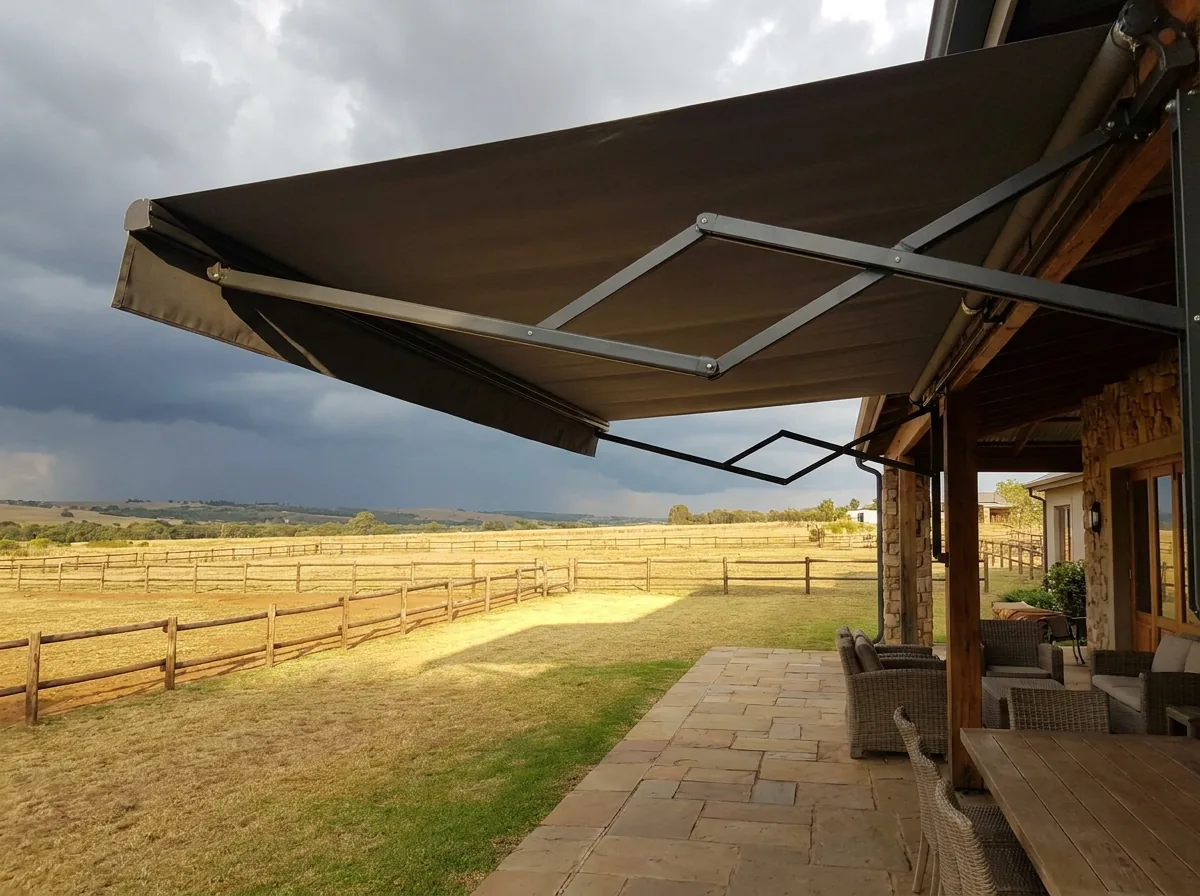
Folding-arm awnings

Verandas facing the paddock

Where the outdoor room is the point of the house — as it usually is here — an awning over the paving buys more usable house than anything you could do to a window, and unlike a fixed roof it folds away for the winter sun.

The trade-off

Storms roll through most summer afternoons[6] and this is hail country[7], so we would specify a wind sensor and a cassette that closes over the fabric.

Also at the foot: vertical & panel blinds for stacking doors, zip screens to hold an open patio against wind, skylight & shaped blinds for gable glass, concealed / recessed blinds where a ceiling can still be planned around them, motorised curtain tracks, and motorisation — which on wide glass decides whether a blind gets used at all.

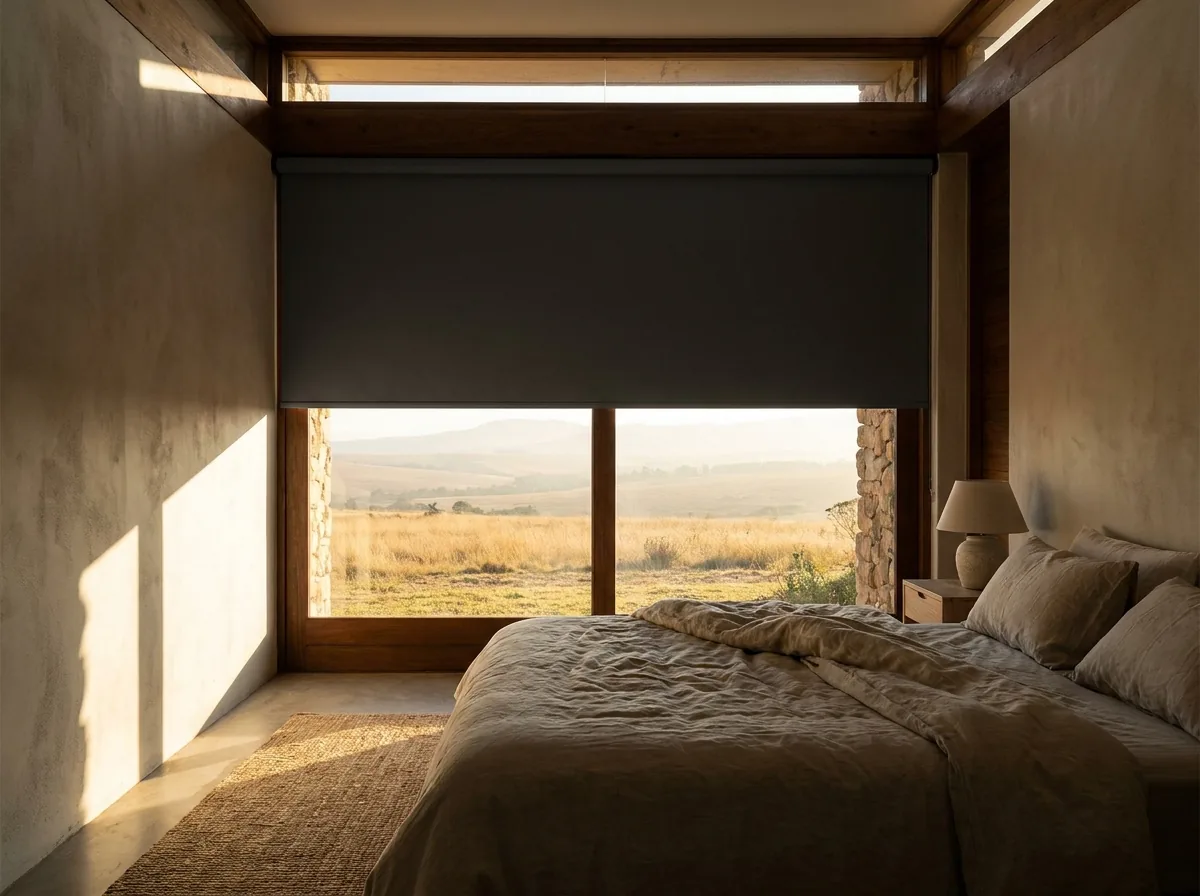
A main bedroom at sunrise with a large east-facing window, a single flat blockout roller blind lowered most of the way down the glass with no folds or slats, hard early light striking the wall beside it while the room stays dark
East bedroom, five past five in December. A flat blockout sheet is the bluntest instrument on this list and exactly the right one here — as long as it's made to sit tight in the reveal.

05 — The local constraint

Estates, schemes and building work.

Inanda is dominated by large freehold stands[2]. If yours is one, nobody's permission is needed for an awning, an external venetian or a roller shutter.

Inside a sectional-title scheme the rule is different. Under the prescribed conduct rules made with the Sectional Titles Schemes Management Act, an owner must not, without the trustees' written consent, change the external appearance of a section or its exclusive-use area, unless the change is minor and does not detract from the appearance[10].

  • Interior blinds inside an existing reveal change nothing outside, so the question doesn't arise.
  • Exterior products — awnings, external venetians, roller shutters, zip-screen channels — do change it, so in a scheme that's a trustee conversation before a quote.

We fit blinds; we won't speak for your trustees. At the measure we say plainly which options touch the outside, so the right question reaches the right person before anything is ordered.

Building or renovating? Get us in early: a concealed ceiling recess has to exist before the ceiling closes. SANS 10400-XA:2021 also requires a fenestration calculation once glazing passes 20% of floor area — up from 15% — and no longer distinguishes the solar heat gain requirements of west, north and east glazing[9]. On a house built around a paddock view that calculation arrives sooner than owners expect.

06 — The honest limit of a guide

What we'd still need to check on site.

Everything above is what we know about Inanda. What no page can know is your house — and five things decide the actual specification, all settled in about an hour with a tape, a compass and a torch.

Reveal depth, and whether the opening is square

Depth decides whether a blind can sit inside the opening at all, and how much light creeps around the edge. Openings are rarely square, and a few millimetres changes how the blind is made.

What the wall is actually made of

Plaster over brick, a later drywall addition, or an aluminium frame with nothing behind it. The fixings decide what can safely hang there — and outside, whether the job is possible at all.

Which way it really faces, and what's growing outside

We take a compass reading, because twenty degrees moves the answer between west and south-west. Then we look out: the tree doing half your shading differs at every window, and half of it falls off in winter[6].

Where the power is, and how it reaches the window

For anything motorised the constraint is the route from a power point to the top of the opening — battery or wired, chased in or surface-run. A walk-around with a torch, not a guess over the phone.

Wind exposure on the open side

Awnings and zip screens live or die on this. A sheltered courtyard and a veranda facing down an open paddock want different products, fixings and sensor settings — obvious in two minutes on the paving.

A folding-arm awning with a flat taut canopy extended over a paved veranda, its articulated arms visible underneath and no support posts, looking out over paddock fencing with a highveld thunderstorm building behind
The veranda question. Projection, fixing height and wind exposure all get decided standing on the paving — and with storms most summer afternoons, the sensor is part of the specification.

07 — Two ways forward

Book the free expert measure.

A consultant comes to the house with samples, measures every window properly, and leaves you with a quote itemised per window. It costs nothing and commits you to nothing. If you'd rather have a rough number first, the ballpark window list sits inside the form below.

Free in-home measure and a written quote per window
A real consultant comes out with samples, not a call centre
Nothing is made until you've approved the quote
Still deciding? Say so on the form and we'll leave you be

We take five or six measure appointments a week across Inanda and the suburbs around it, so the diary fills early — worth booking ahead if you need a particular day.

Anything you added while reading is already ticked on the form.

What are you interested in? (tick any)
Want a ballpark figure first? Open this — about two minutes.

Inanda Blinds — window list

Walk the house, fill this in by hand, then type it into the form on inandablinds.co.za when you get back. Measure the width first, then the drop, in millimetres.

Pop in rough sizes and we'll send a budget range by the next working day. Not sure how to measure? Leave it blank — our consultant measures for free and you'll get exact per-window pricing either way. This part is entirely optional, and nothing here is binding.

Room Width (mm) Drop (mm) Inside / outside reveal Product Remove

Nothing on the list yet — and it stays entirely optional.

Anything you enter here travels with your enquiry as plain text. No uploads, no third-party services, nothing stored anywhere else. If photographs would help, a consultant will simply ask for them in the reply.

POPIA: your details are used only to arrange your free in-home measure and consultation call-back, and are never shared with anyone else. If you tell us you're still researching, we won't call you.

Neither, for now

Just take the guide, marked up

Not ready for a visit or a number? Tell us which rooms are the problem and we'll email this guide with your elevations noted against it. Nobody phones.

POPIA: used only to send you this guide. Never shared with anyone else.

Working out

Sources.

Every geography, climate and legal claim above traces to one of these. Where we've reasoned rather than cited, we've said so in the text.

  1. Inanda, Gauteng — suburb coordinates 26°07′16″S 28°03′25″E, an area of 0.55 km², a 2011 census population of 842, its position in Region E of Sandton about 1.5 km from Sandton City, and the Inanda Club described as an elite equestrian and polo establishment. en.wikipedia.org/wiki/Inanda,_Gauteng
  2. SA-Venues — About Inanda, Sandton: "a peaceful and secure suburb, mostly due to the relatively large size of the properties here", a suburb that "lies in a corridor of green, accentuated by the lush gardens and the presence of ancient trees", "synonymous with the Inanda Club, a premier polo ground", bordered by Atholl, Illovo and Parkmore, and originally a farming community. sa-venues.com — about Inanda
  3. Harcourts — Inanda area profile: the suburb's shift from a farming community to upmarket residential during Sandton's expansion, its "luxurious homes, beautiful gardens" and "wide streets", and Sandton CBD roughly 3 km away. harcourts.co.za/area-profiles/sandton/inanda
  4. The Inanda Club — About: founded in 1934 and "officially opened on 27 April 1935 to provide a home for equestrian sports", originally "located in what was then the countryside north of Rosebank". inandaclub.co.za/about
  5. Conradie, D. (2018) "Sun, shade and natural daylight in South African town planning, with emphasis on Pretoria", Town and Regional Planning 73:47–67 — solar noon elevations of 87.7° on 21 December and 40.84° on 20 June, a December sunrise azimuth of 116.62° and sunset azimuth of 243.35°, the observation of "how much hotter the afternoons (western exposure) are in comparison with the mornings", and the guidance that a horizontal overhang is "mostly suitable for altitude-/elevation- … dominated solar angles, typically on northern (or near northern) facades". scielo.org.za — S2415-04952018000200005
  6. Johannesburg — elevation of 1,753 m, subtropical highland (Köppen Cwb) climate, afternoon thundershowers from November to March, annual rainfall of 713 mm concentrated in summer, June and July night minima around 4.1 °C with occasional sub-zero nights, and roughly six million trees of which 4.8 million are in private gardens. en.wikipedia.org/wiki/Johannesburg
  7. Punge, H. J. et al. (2023) "Characteristics of hail hazard in South Africa based on satellite detection of convective storms", Natural Hazards and Earth System Sciences 23:1549–1576 — hail events concentrating along the Highveld, most frequent from mid-November through February, and peaking in the afternoon. nhess.copernicus.org/articles/23/1549/2023
  8. Hong Kong Observatory — ultraviolet radiation at high altitude: "For every 1000 m increase in altitude, the UV radiation level will increase about 12%", because thinner air filters out less of it. hko.gov.hk — UV radiation at high altitude
  9. Roos Architects — a summary of the revised SANS 10400-XA standard (2021 edition): the fenestration threshold rising from 15% to 20% of floor area, and the removal of any distinction between the solar heat gain coefficient requirements of glazing facing west, north or east. roosarchitects.co.za — revised SANS 10400-XA
  10. Prescribed Conduct Rule 5(1) under the Sectional Titles Schemes Management Act 8 of 2011 — trustees' written consent required before changing the external appearance of a section or exclusive-use area, unless the change is minor and does not detract from the appearance. stratafin.co.za — sectional title appearance rules · gov.za — Sectional Titles Schemes Management Act 8 of 2011

Three honest caveats. The solar figures in source 5 are calculated for Pretoria at about 25.7° south; Inanda sits at roughly 26.12° south, so its own angles differ by well under half a degree — we have quoted the published figures rather than invent our own. The 1,753 m elevation in source 6 is published for Johannesburg as a city, not surveyed in Inanda; we use it to describe highveld conditions generally, which is what it is good for. And figures circulating online for the polo field's size and the number of horses stabled could not be verified on a first-hand source, so they do not appear above.

Get Started

Now let's look at your actual windows.

One visit, real measurements, a written quote per window — and no obligation to go ahead.

Book Your Free Measure