
Motorised Blinds & Automation
The same motor-plus-sensor logic that protects an awning applies to every exterior product.
Explore →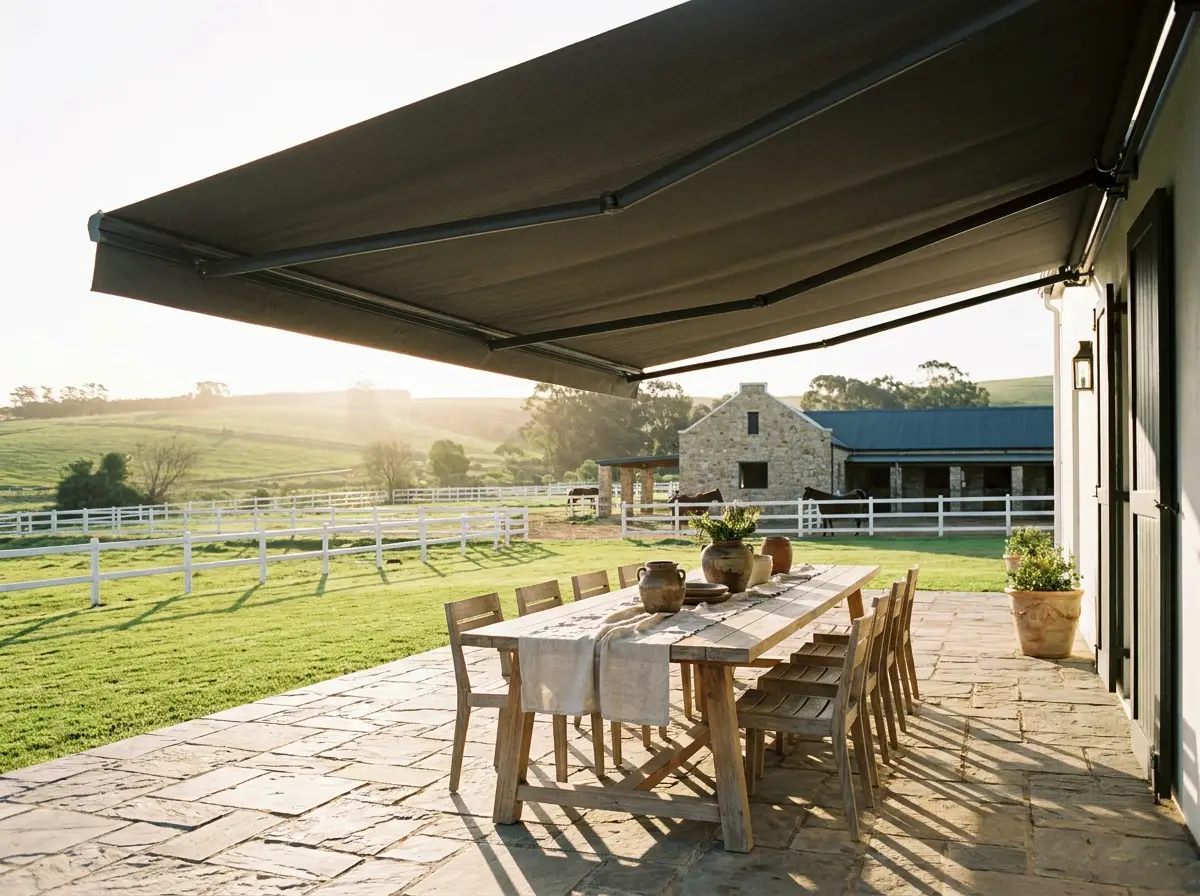
It's also one of the most requested on a stand built for entertaining. No posts means no interrupted paddock view and no clutter around the braai. Projection runs to roughly 3–4m over wide spans, and solution-dyed acrylic fabrics hold their colour under South African UV — an honest consideration on a veranda that gets sun most of the day.
A full cassette seals the fabric and arms away completely when retracted — the right call for anywhere weather-exposed, which most Inanda verandas are. Semi-cassette and open mounting are lighter options for more sheltered positions. LED lighting and a vertical drop-valance are available as premium add-ons for entertainment areas that get used after dark.
A crank handle works, but motorised control with a wind sensor is what we'd recommend on an open stand like Inanda's — an awning caught extended in a sudden highveld thunderstorm gust can be destroyed. Auto-retract protects the investment before anyone's had to run outside and wind it in by hand.
An awning is a shade product, not a rain product — it copes with light drizzle at a pitch, never storm rain or standing water. Wind ratings are real limits, not marketing numbers. And the fixing substrate matters: brick, timber and steel all take the arms differently, which is exactly why this one needs a site assessment rather than a phone quote.
An awning is costed on the shade it throws, width multiplied by projection, and the guide, installed, is R3,500 to R5,500 per square metre for a crank-handle unit and R5,500 to R7,500 per square metre motorised with a wind sensor. Reach for the deeper projections, or a full cassette that shuts the fabric out of the weather, and you are at the upper figure.
A short awning over one door carries a minimum charge, because the arms, the cassette and the wall fixing are unchanged by width. The wall, the substrate, the projection and how exposed the stand is are all assessed at the free measure, and the written price for your patio follows that visit.
Not sure this is the right product for your elevation? The Inanda Paddock-Light Field Guide works through north, west, east and south glass in turn, and says plainly where this one wins and where it doesn't.
Entertaining terraces built for South African hosting aren't unique to Inanda — the same folding-arm awnings go up over patios in Sandhurst and Bryanston, and on the verandas of Hyde Park and Atholl's older homes.
Fixing substrate, projection and wind exposure all need a look in person before we quote.